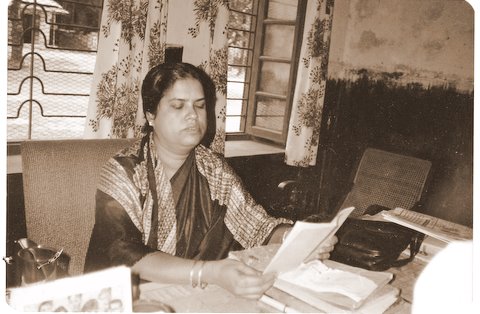
This post is dedicated to Ms. Syeda Z. Noor - a daughter, a sister, a wife, a loving mother of three, a grandmother, and a role model for many in her community. She was the Principal of a Girl’s College in Dhaka, who retired in 2000, diagnosed with Breast Cancer in 2003, and passed away in December 2005. For last couple years the Pink Ribbon has taken a shape of her whom I wish I met. ~ Shahnaz
During the month of October in US, it is hard not to notice the ˜Pink Ribbon” which symbolizes Breast Cancer every where we look. The campaign against breast cancer doesn’t stop only in advertising, the information about the disease and prevention is easily accessible at the hospitals, clinics and of course on the internet.
According to the American Cancer Society, over 215,000 women in USA are diagnosed with breast cancer every year. A person over the age of 50 accounts for 75% of breast cancer cases, the cancer is treatable and there is over a 96% five-year survival rate when breast cancer is caught before it spreads to other parts of the body.
So it seemed a little bleak when I was unsuccessful to find any information regards to Bangladeshi women on the same topic when I searched the net. Even my acquaintances at the medical field echoed the same feelings of despair, one physician responded’I searched all possible databases. We don’t have any published database on breast cancer. If there are some statistics compiled in last two years, those are not published yet. Absence of any database is itself is the worst possible statistics you can come up with.
Then I heard from my friend Pusha, who said, So far what I found only said that an estimated 17% of reported cancer cases among Bangladesh women are breast cancer patients. At the same time they say that the reason they cannot be absolutely certain is because there might be unreported cases as well specially in the villages for instance.
To say the least, my search for statistics, or to find names of hospitals, clinics or organizations which specializes on Breast Cancer in Bangladesh is not easily accessible on the internet.
Then I called my friend for whom the subject was very close to his heart, he lost his mother from breast cancer last year. Considering his recent ordeal, I wanted to make sure it was okay to discuss his loss with our readers, he said, Yes, of course, ˜awareness is the first step to conquer the disease, I want to share my experience, especially since in our culture we don’t talk about this, and we must
He told me, first few months when his mother discussed her pain with the doctors, they shrugged it off as a normal pain due to old age, they suggested her to take vitamins, or to walk off the pain. The retired Principal was anything but inactive in her life; yet, numerous trips to the doctors and complains about her pain didn’t alarmed anyone to recommend her to a mammogram test. By the time someone noticed the tumors on her body, it was too late; the cancer had spread through her body, Months of oversight of the local physicians prompted the family to take her to Singapore and then to Malaysia for treatment, she seemed to do better with chemotherapy, but, due to logistical concerns she was back in Bangladesh, and started her treatment all over again. My friend wasn’t sure if it was the arrogance or ignorance on the part of the doctors who disregarded her previous treatment and started new medicine. Her health started deteriorating. Soon she was in coma, and in a month all her pain and suffering ended when silently bid final farewell to her loved ones.
I don’t know if it’s the oversight of our health professionals, or our hesitation to talk about the disease which prevents us from getting the information which we need to reduce our risk. As my friend requested we must bring this topic to the open, we need talk to our physicians, especially if when we are over 40, or have a family history of breast cancer, we need to ask our physicians what steps we should take to reduce our risks. We need to learn and share with others. We need to take care of ourselves, take care of our family and our loved ones, because we all deserve it.
October 17th, 2006 at 12:05 pm
I have very little knowledge on this subject. Knock on wood I haven’t have anyone close suffer from this very common and deadly disease. But I did see my co-worker Linda suffer thru the whole thing. But she is the one among the fortunate ones who fought it and got rid if any signs of breast cancer from her body. I watched he as she had family and friends support her all the way and encouraged her and took care of her during the impossible days. I prayed for her and wished to God that she makes it thru. Now after one year she is very healthy.
From Linda’s survival story I know that early detection is the best way to fight it. So, Mamograms after 40 is a must. Encouraging friends and family to go to regular check ups is the first step. I know my generation women are more aware about their health than my Mom’s generation. So, let’s start encourage our friends and family and ourselves too, to take better care of our health from now.
October 17th, 2006 at 1:32 pm
A much needed post. Look forward to seeing more like this in the future.
With advanced therapeutic options, breast cancer is rapidly becoming a curable cancer, with current 88% five year survival rate. So, if diagnosed relatively early, most of the patients is expected to live.
In Bangladesh one problem is that we don’t know the extent of the disease. In western nations, breast cancer screening has proven feasible because there are a certain number of new cases in the community. In Bangladesh, we may not have that much breast cancer, making a nationally mandated screening program impractical. On the other hand western countries don’t screen ovarian cancer because the numbers are not that high. But, unlike western societies, in case of Bangladesh, I feel we have more ovarian cancer that may make a national screening program feasible. So bottom line is that we have to tailor our own management scheme, we simply can’t blindly follow western text books.
Our medical education system is flawed to the extent of non existence in training physician how to suspect and investigate a potential cancer.
So who will change it? We, the community, have a lot of responsibility also. Patients, survivors, families, expatriates, women’s orgs can float breast cancer society/foundation etc and start their own work that will include fund raising, national awareness, physicians training, funding cancer research, creating database. Most of the work in USA and Europe are achieved by this sort of community run societies.
October 17th, 2006 at 2:37 pm
I have an action plan. In fact I put this in Drishtipat’s “Health and Safety” plan of action WIki folder. And almost six month ago, I envisioned Adhunika as potential partner.
The Heart Truth Campaign in USA takes a variety of steps to promote the awareness of heart disease as the number one killer of women. One of the programs is national wear red day. Every first Friday of February, women will wear red to promote the cause.
Adhunika can do something for Bangladesh. Fix a date, all women, students, girls, working women etc will wear Red dress to raise breast cancer awareness.
It wil not be too difficult to pursue. A couple of dedicated person in Adhunika may do it. Dp can also be partner.
Start by making some phone call. An alumni call Principal of Holycross college, call some current students in DU, call the VC of the some private university, may involve some NGO ( Call Naripokhkho etc.) . It will be great if a media outlet (Channel, Newspaper) may be included.
Start with a few women here and there in few institutions in the first year. I am sure this will spread rapidly all over the country. It didn’t take Mr. Shafiq Rehman too much effort to popularize Valentine’s day in Bangladesh.
If we have some volunteer who can donate some time and effort, from next year there may be a “national wear a Red Shari “ day all over Bangladesh to raise the awareness of breast cancer.
And please let’s not forget heart disease in women. So far this is possibly the number one killer in Bangladesh also.
October 18th, 2006 at 8:05 am
It is true that not very many credible researches have been conducted in order to be able to establish the prevalence, treatment, and raise awareness regarding breast cancer here in Bangladesh. I am citing a few published papers… even these will give you a feeling that not much has been done in this area… however, this is a start and interested people can pick it up and do more… I think Naripokkho is doing something in this line, but you would know much better…
1: Cancer Detect Prev. 1986;9(3-4):203-5.
Facts and figures about cancer in Bangladesh.
Rahim MA.
During two decades, beginning in 1960, there was a ten-fold increase of cancer registration in Bangladesh. Lung was the most common site (17-19%) with a 14-fold increase. Cancer of the larynx constituted 14%-15% and malignant lymphoma 5%-7% of all cancers. Cancer of the esophagus was the fifth most common cancer in both sexes (3-6%), and its registration increased 11-fold. In women, cancer of the cervix was the most common lesion (23-29%) and breast cancer was second (16-18%). Registration of cervix cancer increased 39-fold, and that of breast cancer increased ten-fold. Cancer of the oral cavity constituted 26-29% of all cancers.
2: Cancer Detect Prev. 1986;9(3-4):195-202.
Cancer in Bangladesh: a model for some problems and proposed solutions in the Third World.
Carr BI.
Bangladesh typifies Third World cancer problems. Soluble problems include 1) assessment: establishment of national and hospital-based cancer registries for factual assessment of incidence and prevalence rates, which are different from those in the West and commonly include cancers of the head and neck or oropharynx, lymphoma, bronchus, esophagus, uterine corpus and cervix, penis, and hepatocellular carcinoma. These facts have consequences for 2) primary prevention. Three common cancers may be preventable–bronchus (smoking), head and neck (alcohol, tobacco and betel nut chewing, smoking), and hepatocellular carcinoma (mold contamination of unrefrigerated stored grains, hepatitis B vaccination). Four common cancers are often amenable to definitive treatment if only they are subjected to 3) early detection. These are cancers of the oropharynx (leukoplakia), cervix uteri (Pap smear), breast (self-exam) and hepatocellular carcinoma (serum alpha-fetoprotein levels). In addition, an analgesic plan at all levels of health care delivery might be instituted. These are practical, low-technology, and cheap and might result in the relief of much misery.
3: Gan To Kagaku Ryoho. 2002 Feb;29 Suppl 1:10-5.
Existing situation & problems surrounding clinical oncology in Bangladesh.
Alam AM.
Department of Radiotherapy, Chittagong Medical College Hospital, Chittagong-4203, Bangladesh.
Over all Government health infrastructure for health care delivery in Bangladesh is very good, though current scenario in relation to the Clinical Oncology in Bangladesh administered by a National Council for cancer control is inadequate. And the facilities for creating cancer awareness, screening, diagnosis, and treatment (i.e. multidisciplinary approach, radiation treatment facilities, availability of cancer chemotherapeutic agents, palliative care facilities are not sufficient enough to meet the need of cancer afflicted patients. Most of the patients present themselves in an very advanced stage due to illiteracy, ignorance, lack of cancer awareness, religious prejudice, cheaper and easy availability of non traditional i.e. quackery treatment, inadequate diagnostic facilities to most of the cancer centers, and low socioeconomic status. Top ranking malignancies in male are: Bronchogenic carcinoma, carcinoma of the oropharynx, esophagus, oral cavity, stomach, hypopharynx, carcinoma of unknown primary sites (CUP), lymphoma and carcinoma of the liver. Top ranking malignancies in female are: Carcinoma of the cervix, breast, esophagus, bronchus, oropharynx, ovary, larynx, stomach, oral cavity, & hypopharynx. Irrespective of sex, the top ranking malignancies are: carcinoma of the bronchus, esophagus, oropharynx, cervix, & larynx. Head neck cancers comprise about more than one third of all malignancies, which is more significant findings in our country. Early detection and prevention of cancer deserves a serious thought and urgent attention especially for developing country like ours, where cost benefit analysis is the predominant factor.
_______________________________
Thanks for the post S… you are doing a wonderful job… keep it going…
October 18th, 2006 at 1:36 pm
This is a topic close to my heart as well. My Mom is one of the fortunate ones in Bangladesh who survived breast cancer. She is now a 6 years survivor. Thanks to God two of my sisters are doctors practicing in Bangladesh. Due to their awareness and care, an early diagnosis and very prompt surgery was possible even in Bangladesh. But shouldn’t my Mom was so close to someone in the medical practice, I don’t know what could have happened.
A support group was very needed at that time. Experience from ones who had gone thru the process and survived was very encouraging for my Mom.
I am very much in favor of the idea of raising awareness. Red dress, pink ribbon, we can implement all these with proactive volunteerism.
October 22nd, 2006 at 10:42 pm
Thank you everyone for your responses, especially for sharing your personal experience with us. I am glad we all agree that we need more awareness about Breast Cancer.
Thanks for great suggestions - I believe it should not just stop at awareness, we need to take a step further in identifying the institutions with a Cancer Unit which are doing exceptional work in serving clients, creating support for the family and tracking the disease, and rest can follow their footsteps. I am anxious to learn about such services in Bangladesh, does anyone know of such institutions?
October 27th, 2007 at 11:01 pm
Hi Shahnaz,
I was trying to get information on breast cancer in Bangladesh and have had little luck. I happened to come across your blog site this morning and would like to invite you today Oct 28th at 3pm to Spectra Convention Center in Gulshan 1. Nokia is sponsoring a two week long breast cancer awareness program jointly with Bangladesh Cancer Foundation Hospital.
It would be a pleasure to have you with us.
Kind regards,
Shabnam
October 28th, 2007 at 12:41 am
Shabnam,
Thank you for the invitation, unfortunately unable to attend. would appreciate if you keep us posted on your findings at the conventation.
On October 25, we held our Community Outreach Initiative in Midtown New York, it was fascinating to find out the challenges the Bangladeshi women who are diagnosed with the cancer.
We hope to share our findings with our readers from our participants at the event.
best,
Shahnaz
November 5th, 2007 at 4:21 pm
Hello Shanaz,
I just read through ur blog. I wanted to know if you could manage to get information on Breast Cancer in Bangladesh. I am very interested in creating an outreach or information network for the young girls at home.
Looking forward to your reply.