
* domestic violence: breaking silence
I walked up the stairs of a two story brick building in Jackson Heights with an uncertainty as to what I may encounter inside. Today’s workshop was being held in a space provided by another organization called Chhaya CDC. I’ve been volunteering Adhunika Foundation for about three years now. Adhunika’s main focus has been to promote technology usage for Bangladeshi women worldwide in the hopes of bringing about a positive social change to their lives. October is Domestic Violence Awareness month.This is the second time our organization has actively partnered up with another organization called Shakti Peer to address the issue of Domestic Violence (DV) with the hopes of raising awareness by providing a series of workshops and resources for women within the Bangladeshi community.
In passing through the entrance, I heard the murmurs of female voices and continued to walk until I had a visual sight. My eyes laid upon a handful of women, all smiling as they were talking to each other. Their presence in the room filled the air with a sense of purpose and I felt humbled to be amongst them. I saw Shahnaz Yousuf – Founder of Adhunika and embraced her, she then introduced me to our coalition members of Shakti Peer Group as well as others that were present for the workshop. I was relieved to see another common face in the room, also a dedicated volunteer of Adhunika, Baby Aziz. But I was dismayed that only a handful of people came to attend the workshop.
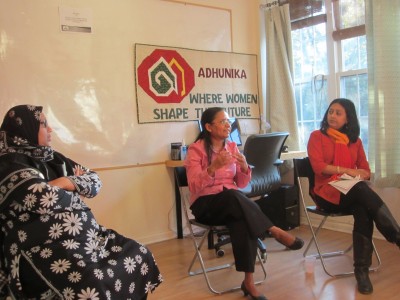 The seating arrangements were formed with chairs to form a semi-circle in the middle of a room and I seated myself by the window. The members of Shakti Peer Group looked to be in their 30s-40s coming from very diverse backgrounds but spoke English and Bangali quite fluently. After we all sat down, Mahbooba Akhtar Kabita facilitator & member of Shakti Peer Group opened up the workshop by introducing the topic of Domestic Violence. Each of us picked a small phrase out of a random pile and was told to find our partner that had the other half of the phrase. After we identified our partner, we realized that the two halves completed a sentence of a Bangladeshi proverb.
Though I can read Bangali language, interpreting the words of a proverb was beyond my skill set. I asked my partner, Afreen Alam the Deputy Director of Chhaya CDC for interpretation of the proverb. She smiled and uttered the English translation which meant, “Patience Yields Results.” We were then asked to find out some basic background information of our partners and to also discuss what the proverb meant to each one of us. The floor was then opened to the bigger group to discuss the proverb each team had. As each team discussed their chosen proverb, a theme started to form and I realized that these proverbs were distinctly selected because of the underlying negative influence it has on women culturally.
Once the ice breaker session was completed, Kobita apa dived deeper into the topic. She discussed in detail the factors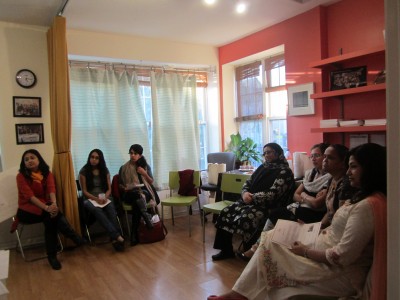 (external/internal) that contributed to domestic violence. She spoke and interacted with the audience from defining the situation to challenges of guiding potential victims through the process. Each of us contributed to the discussion, it was interesting to hear how each of us perceived DV in a different way. In the middle of the discussion, I learned that a member of Shakti Peer Group was a survivor and she spoke so candidly about her past experience that I was taken back by the confidence in her voice. There was a general consensus that for Bangladeshi women the underlying root cause of DV is that it is accepted in our society. Due to the time constraint, the two hour discussion had to come to an end. By now I had more questions than answers in my mind. I didn’t expect to solve a social issue within a few hours, but I struggled to identify what the starting point should be. We bid farewell to our partners and the members of Adhunika, including Shahnaz, decided to head over to a local eatery in Jackson Heights where we picked up the conversation once more.
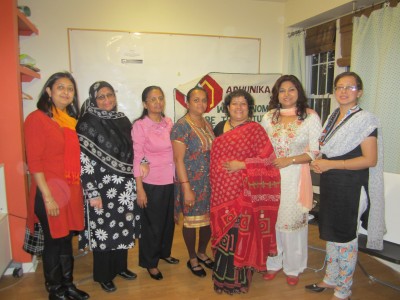 Over dinner we discussed what the best approach may be for our organization to tackle this. A key concern was how to obtain space to conduct these workshops regularly. We want people who attend the workshops to not feel threatened by the environment, to ensure confidentiality until if and when they are ready to leave the situation. People who attend should not fear judgment or feel threatened. We are here to listen to your stories, to provide you with resources in case a time comes where you may need it. The three of us pondered in silence as we finished eating our food. As Kabita apa drew on the white board, it is like a monster with many heads and cutting one off will only create more. Hopefully by our next workshop early January you will feel comfortable to join the conversation for us have more guidance in reaching our goal.
~ Laila Latif, from New York